Between 2011 and 2025 I have made several projects that explore women’s wigs.
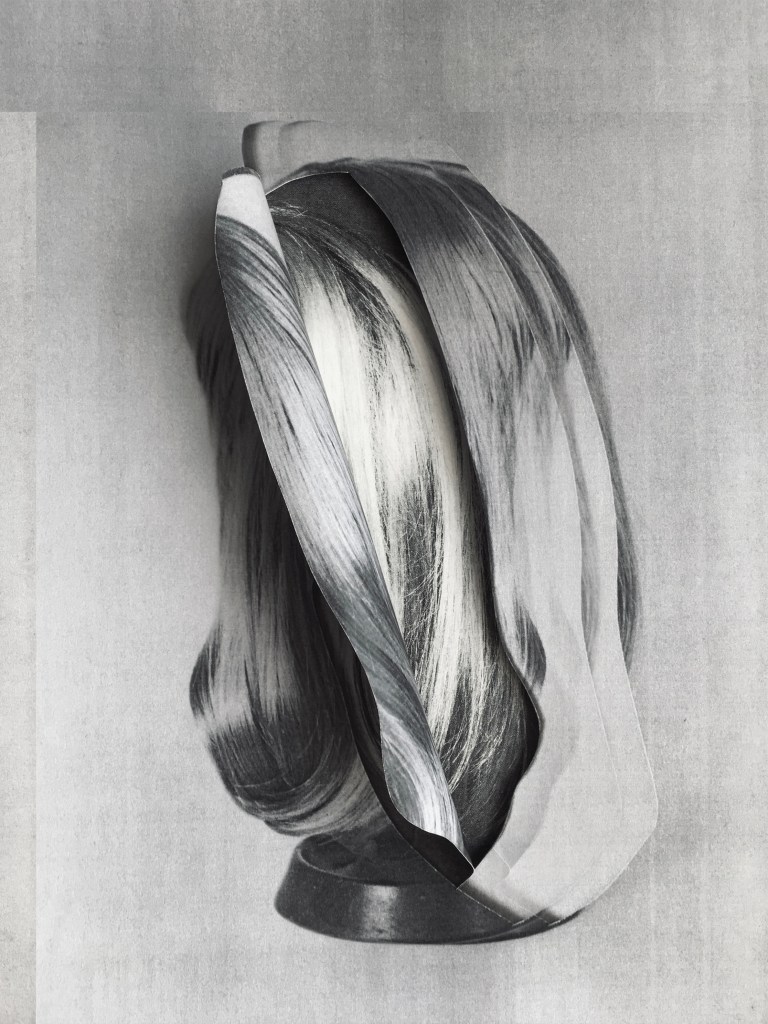
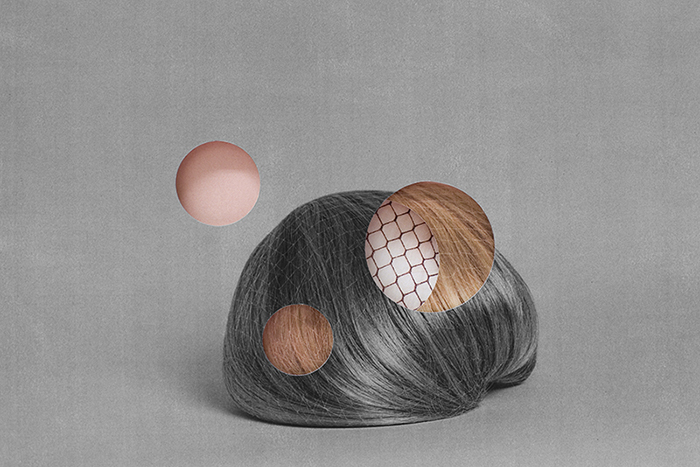
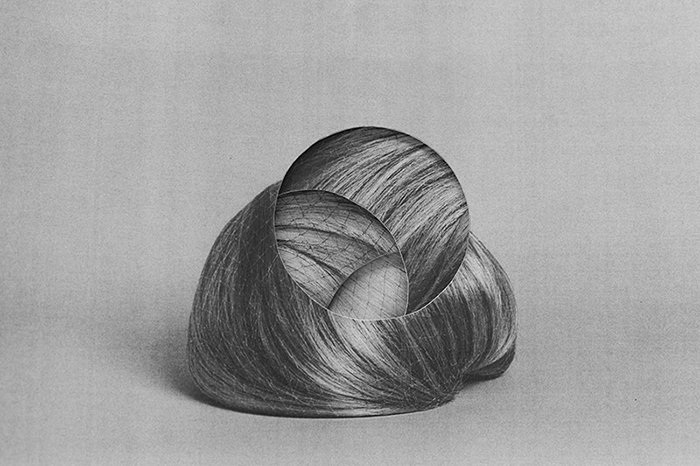
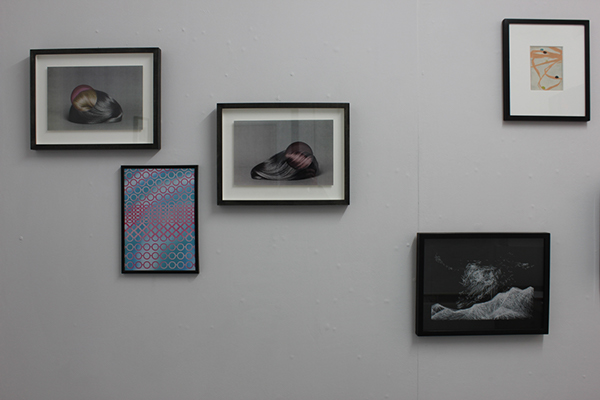
‘Wigslip’ is a series of photographs made from collaged layers of photographs of women’s wigs. Wigs, especially discarded are referencing both literal and metaphorical vulnerability, loss, and transformation. The wigs, once part of a performance of beauty or desirability, become remnants of an identity that has shifted or been stripped away.
Detached from a wearer, they become eerie. Their disembodied nature makes them appear as if they should still be attached to someone. This is particularly emphasized through the forensic-style photography I used in the original pre-collaged photographs, and the series presents wigs as if they were remnants of something lost, something once alive. Wigs are particularly powerful symbols in my work because they embody transformation and instability. Unlike other garments or accessories, wigs exist in a strange in-between state, complicating notions of identity, authenticity, and the body. Wigs are not quite part of the body, yet they are not purely artificial either. They sometimes contain human hair, making them simultaneously organic and manufactured. This contradiction makes them a liminal object, existing between real and fake, animate and inanimate. Wigs highlight how easily appearance can change, underscoring the instability of personal identity. The ability to switch hair (and by extension, persona) in seconds problematizes the boundaries of selfhood, suggesting that identity is just as constructed and mutable as a collage. My technique of cutting and folding photographs of wigs introduces a paradox—by manipulating a flat image, I create an illusion of depth, but one that remains artificial. This plays with the tension between surface and substance, questioning the authenticity of both images and identity. The slippages I introduce suggest that identity is not fixed but continuously reconstituted through objects, surfaces, and representations that never fully resolve.
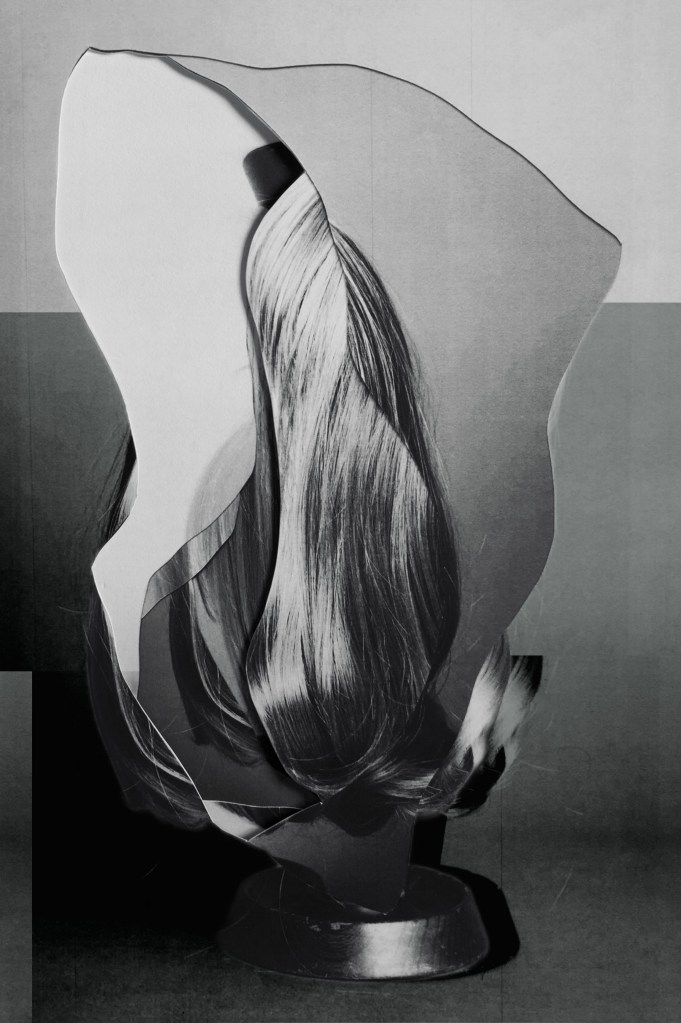


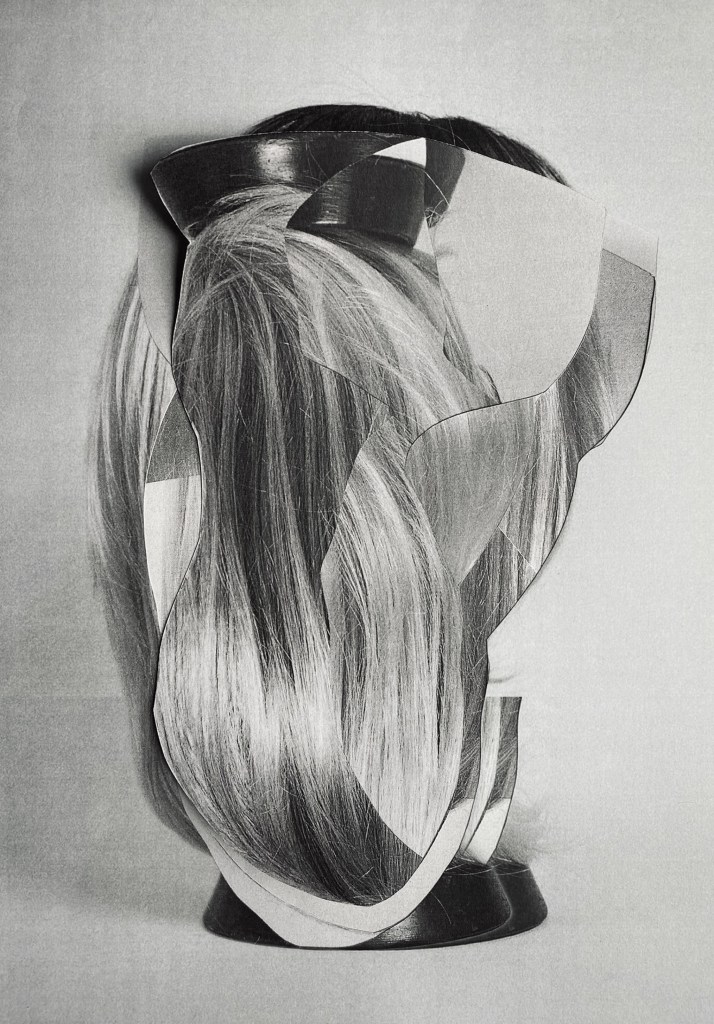
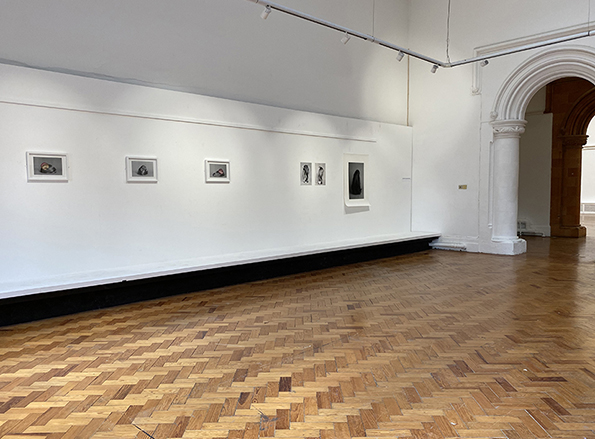

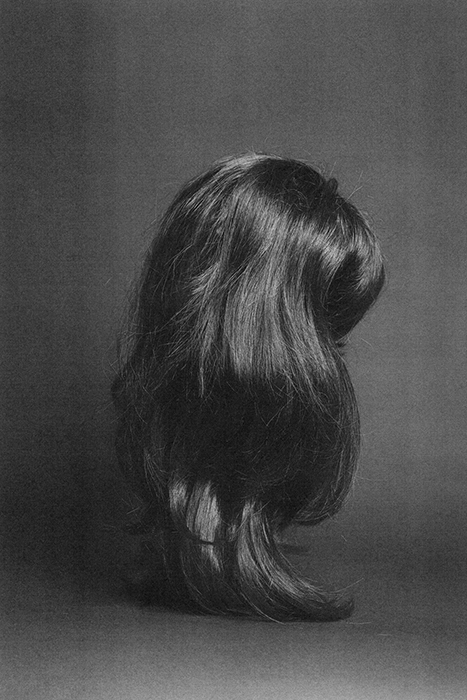
‘Wigs’ has been informed from a previous documentary study into the vestiges and detritus left lying around in a red-light district in Manchester. I became interested in fallen hair pieces (artificial extensions, weaves, etc) that I regularly found in the street. These were graphic metaphors for what went on in the area, either as evidence of broken femininity, quite literally ‘fallen woman’, or as symbols of the underlying violence that the women risked working there, they could also represent the evidence of sloughed off remains of women who had shifted from one social state to another, from one persona to another.
The project utilised wigs as a way of abstracting from the specifics of the sex industry in order to explore female sexual identity in broader terms. Confusion hangs over an abandoned or unused wigs – they look organic, even though we know they’re not. Amputated from their intended context like this, they trigger in us a very deep-seated sense of the unease. The minimal, forensic style of photography further emphasises their link to the uncanny. They are just wigs, dead, inert, they pose no danger; yet they look like they could unfurl, at any moment, and come to life.
The photographs are titled according to the names given to the wigs by manufacturers but by trying to adopt certain personalities they are only highlighting their ambiguity, and speaks of a lack of interior, a void, which draws attention to their surfaces, and the fragility of identity – in this case the representation of female desirability and sexuality.
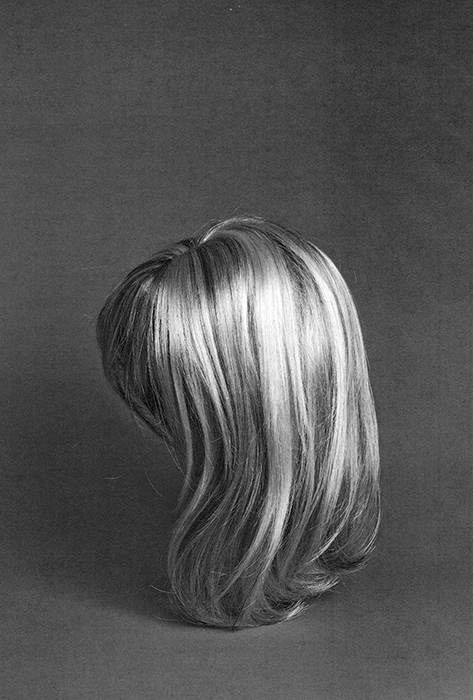

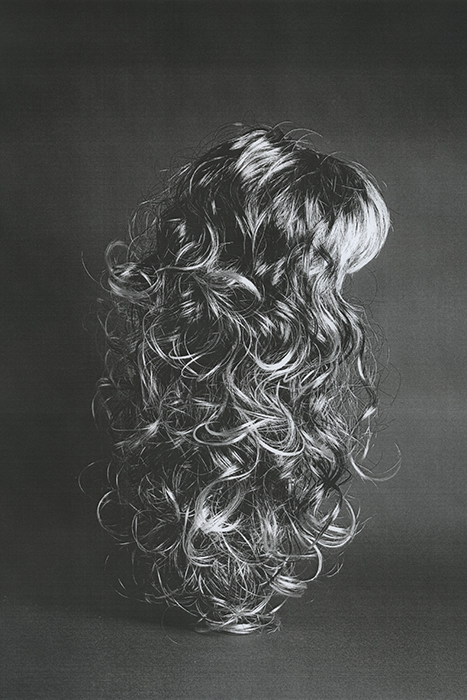
Penetralia builds on Wigs, but rather than explore narrative and symbolic associations around the posed wig, I removed the ‘body’ from the wig so as to explore its suggestive possibilities in its ‘formless’ state. Wigs are intended to be worn on the body, they are easily subsumed on to the body’s surfaces, but a disembodied wig becomes an object of fascination in its own right – it’s own interior becomes a space for exploration, and a space to question the femininity signified by its exterior.
I have moulded wigs in to forms that draw attention to their ‘object-ness’ and maintain some link to their previous feminising function. I have cut holes through the resulting photographs as a way of opening up the surfaces of the wig – attempting to create playful relationships between interior and exterior, and to generate new spaces where new meanings can be explored.
The word ‘penetralia’ means the inner-most recesses of a building or structure, or the most private or secret part of a thing. It seemed like an appropriate title for the work and refers to my desire to literally and metaphorically shine a light into the recesses of the wig. The title is suggestive and alludes to the link between hair, wigs and sex, as well as having an association with the act of penetrating, or making a hole in something (be it a wig, the surface of a female body, or indeed a photograph).
These fragile paper experiments hint at the flimsy surfaces that make up the masquerade of femininity and further explore notions of the surreal and uncanny in these loaded everyday objects.



 Sarah Eyre